DAF System for Effluent Treatment Plant
Description
Dissolved Air Flotation (DAF) System for Industrial Wastewater Treatment
Introduction to Dissolved Air Flotation (DAF) System
Sanskriti Enviro Pvt. Ltd. offers Dissolved Air Flotation (DAF) System solutions designed to support efficient industrial wastewater treatment and contaminant separation. A Dissolved Air Flotation system is a wastewater treatment technology that uses fine air bubbles to separate suspended solids, oil, grease, and other floatable contaminants from water. It is widely used in industrial applications where wastewater contains floating impurities, emulsified oils, and suspended particles that need to be removed before further treatment or discharge.
Industrial wastewater often contains a mixture of organic and inorganic pollutants generated during manufacturing, washing, processing, and cleaning operations. If these contaminants are not properly managed, they can affect downstream treatment processes, increase the load on biological treatment systems, and create operational challenges. A DAF system helps address these issues by improving the separation of floatable and suspended contaminants through a controlled flotation process.
At Sanskriti Enviro Pvt. Ltd., DAF system solutions can be configured according to wastewater characteristics, flow rate, industry requirements, and the overall treatment objectives of a project. The objective is to provide an appropriate wastewater treatment solution that supports effective contaminant removal, operational reliability, and efficient plant performance.
What Is a Dissolved Air Flotation System?
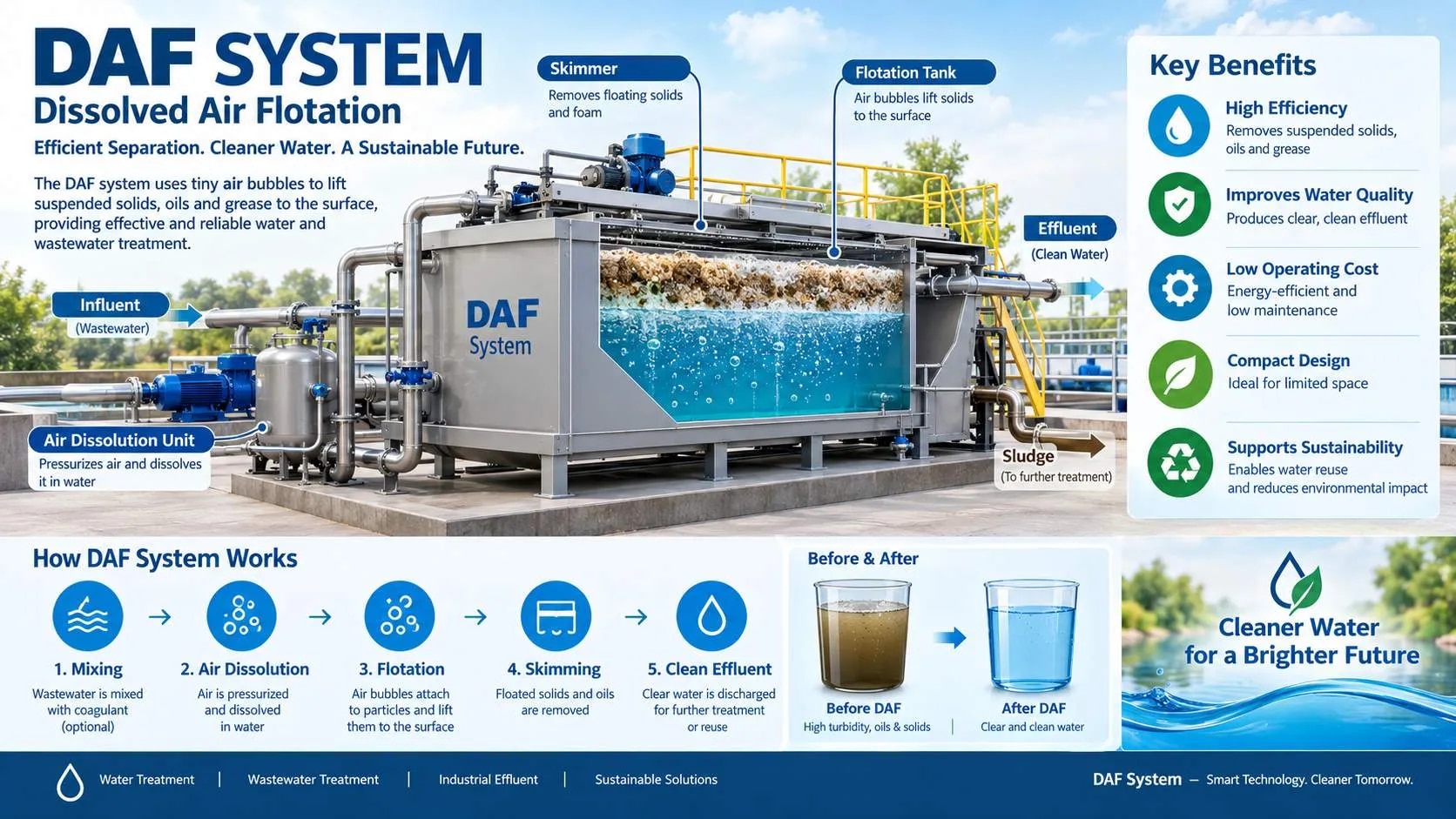
A Dissolved Air Flotation (DAF) system is a physical separation process used to remove suspended particles, oil, grease, and other floatable materials from wastewater. The system works by introducing microscopic air bubbles into the wastewater. These bubbles attach to suspended contaminants and help carry them to the water surface, where the accumulated floating layer can be removed using a mechanical skimming arrangement.
Unlike conventional sedimentation, which relies on particles settling under gravity, DAF technology uses flotation to separate particles that are light, buoyant, or difficult to settle. This makes it particularly useful for wastewater streams containing oil, grease, fine suspended solids, and certain emulsified contaminants.
DAF systems are commonly used as a primary treatment or pretreatment stage in industrial wastewater treatment plants. Depending on the wastewater composition and treatment objectives, they may be integrated with screening, equalization, chemical dosing, biological treatment, filtration, and other downstream processes.
How Does a DAF System Work?
The Dissolved Air Flotation process generally involves the following stages:
1. Wastewater Collection and Conditioning
Industrial wastewater is collected and, where required, passed through preliminary treatment equipment such as screens or an equalization tank. Equalization helps manage variations in wastewater flow and pollutant concentration. Depending on the characteristics of the wastewater, chemical conditioning may also be required to improve the separation of suspended particles.
2. Air Dissolution and Pressurization
A portion of the treated or recycled water is pressurized and mixed with air in a specially designed air dissolution arrangement. Under pressure, air dissolves into the water. When this pressurized stream is released into the flotation tank, the pressure reduction causes fine air bubbles to form.
3. Bubble Formation and Contaminant Attachment
The fine air bubbles come into contact with suspended solids, oil droplets, grease, and other suitable contaminants. The bubbles attach to these particles and help reduce their effective density, allowing the contaminant-bubble aggregates to rise toward the surface.
4. Flotation and Surface Separation
As the bubbles rise, they carry the attached contaminants to the top of the flotation tank, where a floating sludge or scum layer forms. A mechanical skimmer removes this accumulated material for collection and further handling.
5. Treated Water Collection
The separated water is collected from the flotation tank and transferred to the next stage of the wastewater treatment process. Depending on the required treatment quality, further treatment may include biological processes, filtration, disinfection, or advanced treatment technologies.
The overall performance of a DAF system depends on wastewater characteristics, hydraulic loading, air-to-solids ratio, chemical conditioning, and equipment configuration.
Key Features of the DAF System
Efficient Oil and Grease Separation
DAF technology is particularly suitable for wastewater streams containing free oil, grease, and floatable contaminants. The flotation process helps separate these materials from the water, supporting better performance in subsequent treatment stages. The actual removal efficiency depends on the type of oil, droplet size, emulsification, and wastewater conditions.
Reduction of Total Suspended Solids (TSS)
A DAF system helps reduce suspended solids by floating suitable particles to the surface for removal. This can lower the solids load entering downstream treatment units and support more stable plant operation. Chemical coagulation and flocculation may be incorporated where needed to improve the removal of fine particles.
Compact and Space-Efficient Design
DAF systems can offer a compact treatment arrangement compared with certain conventional separation processes. Their configuration can be selected according to available installation space, wastewater flow, and process requirements, making them suitable for a range of industrial facilities.
Customised System Configuration
Every industrial wastewater stream has different characteristics. The DAF system configuration can be selected according to wastewater flow rate, pollutant concentration, oil and grease content, suspended solids, and required treatment performance. Process design may include appropriate pumps, air dissolution equipment, skimmers, chemical dosing facilities, and sludge collection arrangements.
Integration with Existing Treatment Plants
A DAF unit can be integrated into a new wastewater treatment plant or considered for upgrading an existing facility. It is commonly used as a pretreatment stage before biological treatment or other downstream processes, subject to a technical assessment of the wastewater and plant configuration.
Industrial Applications of DAF Systems
Food and Beverage Industry
Food processing, dairy operations, meat processing, and beverage manufacturing can generate wastewater containing fats, oils, grease, and suspended organic matter. A DAF system can help separate these contaminants before further treatment, depending on the wastewater characteristics and pretreatment requirements.
Oil and Petrochemical Industry
Wastewater generated in petroleum processing, refineries, petrochemical facilities, and related operations may contain oil droplets and suspended contaminants. DAF technology can support oil-water separation and wastewater pretreatment when appropriately designed for the specific composition of the wastewater.
Textile and Dyeing Industry
Textile processing and dyeing operations may generate wastewater containing suspended fibres, lint, dyes, and other process-related pollutants. Depending on the wastewater chemistry, DAF may be used with suitable chemical conditioning to improve the separation of suspended and floatable material.
Pulp and Paper Industry
Pulp and paper manufacturing can produce wastewater containing fibres, fine solids, and other suspended materials. A DAF system can help recover or separate suitable suspended matter and reduce the solids load on downstream treatment units.
General Industrial Wastewater Pretreatment
DAF technology can also be considered for wastewater generated by manufacturing, engineering, metal processing, and other industrial operations. Suitability depends on the pollutants present and the required treatment outcome.
Benefits of Using a DAF System
A properly selected Dissolved Air Flotation system can provide several operational benefits:
- Helps remove suspended solids, oil, grease, and suitable floatable contaminants.
- Supports reduction of the pollutant load entering downstream treatment units.
- Can improve the operational stability of an integrated wastewater treatment plant.
- Offers a flexible configuration for different industrial flow rates and wastewater conditions.
- Can be integrated with chemical conditioning and other treatment technologies.
- Supports wastewater management and, where the complete treatment train permits, water reuse initiatives.
- Provides a practical pretreatment option for industries seeking to improve wastewater treatment performance.
Actual results depend on wastewater characteristics, system design, operating conditions, and the performance of the complete treatment process.
Factors to Consider When Selecting a DAF System
Selecting the right DAF system requires an understanding of the wastewater to be treated. Important considerations include the average and peak flow rate, total suspended solids (TSS), oil and grease concentration, pH, temperature, and the presence of emulsified or dissolved contaminants.
The required treated-water quality must also be established. If the objective is to reduce solids and oil before biological treatment, the configuration may differ from a system intended to support a more extensive treatment and reuse process.
Other considerations include available installation space, sludge handling requirements, chemical consumption, equipment accessibility, maintenance needs, and integration with existing infrastructure. Wastewater sampling and laboratory or pilot testing may be recommended for complex wastewater streams or where specific performance targets must be achieved.
Why Choose Sanskriti Enviro Pvt. Ltd. for DAF System Solutions?
Sanskriti Enviro Pvt. Ltd. provides DAF system solutions for industrial wastewater treatment applications, with system configuration considered according to project-specific requirements. Understanding wastewater characteristics and treatment objectives is essential for selecting appropriate equipment and developing a practical treatment arrangement.
From industrial pretreatment to integration with a broader wastewater treatment plant, the selection of a suitable DAF system should consider process performance, plant layout, operating conditions, and future treatment requirements.
Businesses evaluating a DAF system can define their wastewater flow, industry type, pollutant characteristics, and desired treatment outcome to support a more informed technical assessment.
Specifications
| Treatment Type | Dissolved Air Flotation |
|---|---|
| Application | Industrial Wastewater Treatment |
| Contaminants Removed | Oil , Grease and Suspended Solids |